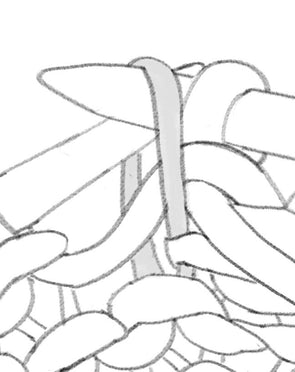
How to Fix Dropped Stitches Part VI: I-Cord Edge Stitches / Slipped Edge Stitches

Fixing dropped edge stitches is daunting enough, but dropped I-cord edge stitches?? Don't panic - we can fix it! With a little patience and some careful organizing, you can save yourself a lot of frogging and get those stitches right back to where they should be.

In this tutorial, Julie shows you how to fix two types of dropped I-cord edges: 2-3 stitch edges that are slipped on one side and knit on the other, and 4+ stitch edges that are slipped and knit alternately on each side (AKA alternating slipped stitches, or double-knit bands).

Recommended Tools...

1

Stitch Fixer

A Stitch Fixer (or crochet hook) will make picking up and fixing the stitches much easier.

Shop Stitch Fixer

2

T-Pins

Use T-pins (or sewing pins) to help organize your yarn strands. T-pins are also included in our Knitter's Block kit, which has self-healing foam blocks that you can lay your work on and stick pins into.

Shop T-pins

Shop Knitter's Block

3

Split Ring / Opening Stitch Markers

If you want to quickly catch individual stitches before slipping them onto your knitting needle, use Split Ring or Opening Stitch Markers.

Shop Stitch Markers

How To...

1

2 or 3 Stitch I-cord Edge

A

Identify your I-cord/slipped edge stitches. If non-edge stitches have also dropped, use the Stitch Fixer (or crochet hook) to pick them up as you would a normal stitch. (Click here for a tutorial.)

B

Place your loose edge stitches on a spare knitting needle, starting with the inner most/back stitch and working your way around the edge to the front. (This is demonstrated around the 1:41 minute mark in the video above.)

Optional: before slipping them onto the needle, catch individual stitches with a Split Ring or Opening Stitch Marker.

C

Identify the loose yarn strands and pin them to the side. They will appear as sideways U-shaped loops, with a top and a bottom strand. Make sure they are not twisted or crossed.

D

Starting with the innermost stitch, use your hook to pick up every other ladder strand. You will skip the bottom strand and pick up the top strand of each pinned loop. (Skipping the bottom strand will mimic a slipped stitch.)

To pick up a ladder strand, insert your hook into the front of your loose stitch, scoop up the strand from behind, then bring it forward through the loop. 

E

Once you have reached the top, place your stitch back onto your working needle (not the spare needle holding your other dropped stitches).

E

Repeat with the remaining stitches, working your way out toward the edge. Note that the pinned loops will shorten as you use them up. Remove the pins as you work the final edge stitch. Check to make sure none of the stitches are twisted on your working needle.

All done!

2

4+ Stitch I-cord Edge (with Alternating Knit and Slipped Stitches)

A

Identify your I-cord/slipped edge stitches. If non-edge stitches have also dropped, use the Stitch Fixer (or crochet hook) to pick them up as you would a normal stitch. (Click here for a tutorial.)

B

Place your loose edge stitches on a spare knitting needle: identify the knit stitches vs purl (AKA slipped) stitches, then start with the outermost stitch and work your way in alternating knit and purl stitches. (This is demonstrated around the 11:17 minute mark in the video above.)

Optional: before slipping them onto the needle, catch individual stitches with a Split Ring or Opening Stitch Marker.

C

Flip your work over so the Wrong Side (WS) is facing up. Identify the loose yarn strands and pin them to the side. They will appear as sideways U-shaped loops, with a top and a bottom strand. Make sure they are not twisted or crossed.

D

With the WS facing, we will pick up the knit stitches. Starting with the innermost knit stitch, use your hook to pick up every other ladder strand. You will pick up the bottom strand and skip the top strand of each pinned loop.

To pick up a ladder strand, insert your hook into the front of your loose stitch, scoop up the strand from behind, then bring it forward through the loop. 

E

Once you have reached the top, place your stitch back onto your working needle (not the spare needle holding your other dropped stitches).

F

Rather than flipping your work from the WS to the Right Side (RS) for every singe stitch, you can move the purl stitches onto another spare needle and hold them behind the knit stitches.

Pick up your remaining WS knit stitches as per the instructions above.

G

Remove the pins and flip your work over so that the RS is facing up. Re-identify the loops.

At this point you do not need to pin them, but it may help orient you. If you pin them, they will appear as "loops" as before. If you do not pin them, they will appear as ladders.

H

With the RS facing, what we previously called the "purl" stitches will now appear as knit stitches. Pick them up by starting with the inner most stitch. If you pinned your loops, you will pick up one strand in each loop. If you did not pin them, you will pick up each ladder.

I

When you reach the top, you will have to place your newly picked up stitch onto your working needle in between the previously picked up stitches, alternating WS and RS (AKA knit and slipped) stitches. Use another spare needle to help you with this. (This is demonstrated around the 17:25 minute mark in the video above.)

J

Repeat with the remaining stitches, working your way out toward the edge. Note that the pinned loops will shorten as you use them up. Remove the pins as you work the final edge stitch. Check to make sure none of the stitches are twisted on your working needle.

All done!

Leave a Comment

Your email address will not be published. Required fields are marked *

Please note, comments must be approved before they are published